
RAFOXANIDE for veterinary use on CATTLE, SHEEP, GOATS
and HORSES against flukes and roundworms
Common name: RAFOXANIDE
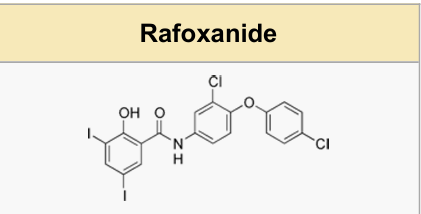
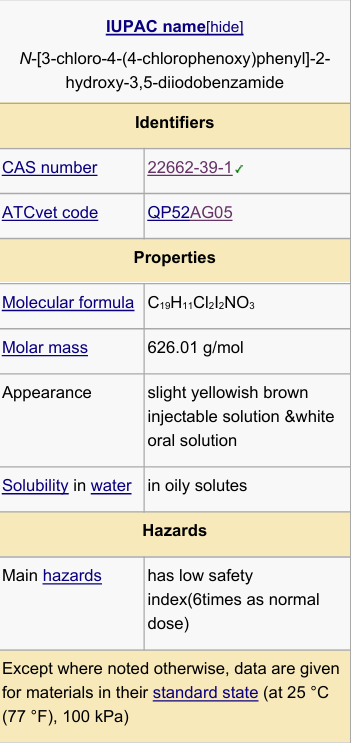
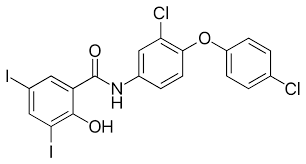
CHEMICAL STRUCTURE :
SPECIFIC FEATURES
Rafoxanide is a veteran, narrow-spectrum flukicide and nematicide. It is still
used in livestock, mainly in ruminants, but has been vastly replaced by
more effective compounds. It is available in the form
of injectables and drenches, often in combination with a broad-spectrum
nematicide (e.g.benzimidazoles, macrocyclic lactones, levamisole)
rafoxanide is not used in dogs and cats
Efficacy of rafoxanide
Rafoxanide is highly effective against adult and immature (older than 6
weeks) liver flukes (Fasciola hepatica and Fasciola gigantica),
against a few gastrointestinal nematodes such
as Haemonchus spp and Bunostomum spp , and also against nasal
myiases caused by the sheep bot fly (Oestrus ovis).
Rafoxanide is not effective against numerous other gastrointestinal
roundworms, lungworms (e.g. Dictyocaulus spp ) eyeworms
(e.g. Thelazia spp ) or tapeworms.
Unlike many other anthelmintics
(e.g. imidazothiazoles, benzimidazoles, tetrahydropyrimidines),
rafoxanide has a residual effect, i.e. it not only kills the parasites present
in the host at the time of treatment, but protects against re-infestation for a
period of time (up to several weeks) that depends on the dose and the
specific parasite
Pharmacokinetics of rafoxanide :
After oral administration rafoxanide is slowly absorbed into the
bloodstream. Maximum blood concentrations are reached 2 to 3 days after
treatment. Rafoxanide binds to >99% to plasma proteins. It is well
distributed throughout the whole body but has a particular affinity for the
thyroid gland.
Excretion is rather slow, mainly through bile and feces, mostly as
unchanged parent molecule. Less than 1% of the administered dose was
found in urine. Excretion half-life is about 10 days. Rafoxanide remains
detectable in blood for more than 100 days after treatment
Mechanism of action of rafoxanide
The molecular mode of action of salicylanilides, including rafoxanide, is
not completely elucidated. They all are uncouplers of the oxidative
phosphorylation in the cell mitochondria, which disturbs the production of
ATP, the cellular “fuel”. This seems to occur through suppression of the
activity of succinate dehydrogenase and fumarate reductase, two enzymes
involved in this process. This impairs the parasites motility and probably
other processes as well.