
What is Closantel?
Closantel is a broad-spectrum anthelmintic used in veterinary medicine to control liver flukes, blood-feeding worms, and some external parasites in cattle, buffalo, sheep, and goats. It is commonly available as Closantel Sodium.
CHEMICAL STRUCTURE :
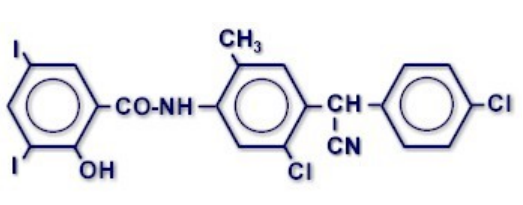
Closantel
CAS registry number (Chemical Abstracts Service): 0057808-65-8
Chemical Formula: C22-H14-Cl2-I2-N2-O2
Molecular Weight: 663
Therapeutic Category: Anthelmintic agent
Chemical Name: Benzamide, N-[5-chloro-4-[(4-
chlorophenyl)cyanomethyl]-2-methylphenyl]-2-hydroxy-3,5-
diiodo
Uses / Indications
Closantel is effective against:
Internal Parasites
- Liver flukes (adult stages)
- Fasciola gigantica
- Fasciola hepatica
- Haemonchus contortus (barber pole worm)
- Bunostomum spp.
- Oesophagostomum spp.
- Gaigeria pachyscelis
External Parasites
- Nasal bots
- Some ectoparasites (limited effect)
How It Works
Closantel works by:
- Disrupting parasite energy production
- Paralyzing and killing the worms
- Having long residual action to prevent reinfection
It is specially powerful against blood-sucking parasites.
Benefits
- Strong flukicidal & wormicidal action
- Long-lasting effect
- Effective even where resistance to other drugs exists
- Improves animal health, weight gain, and milk production
- Safe when dosage guidelines are followed
Dosage (General Guidance — Follow Label Instructions)
Typical recommended dosage:
- Cattle & Buffalo: ~10 mg/kg body weight
- Sheep & Goats: ~5 mg/kg body weight
(Exact dosage depends on brand and formulation.)
Available Forms
- Oral drench
- Suspension
- Injectable (rare)
- Combination formulas (Closantel + Albendazole, Closantel + Ivermectin, etc.)
Precautions
- Not effective against immature flukes
- Do not overdose
- Shake well before use (for suspension forms)
- Store in cool, dry place
- Follow withdrawal periods strictly
Withdrawal Period
- Meat: 28–50 days (depends on brand)
- Milk: Usually not recommended for lactating animals
(Always check product label.)
EFFICACY AGAINST PARASITES:
Type of action: Anthelmintic endoparasiticide, and ectoparasiticide
Main veterinary parasites controlled: liver flukes, certain
gastrointestinal roundworms (= nematodes), various myiases (= parasitic
maggots)