
NICLOSAMIDE for veterinary use on DOGS, CATS and
LIVESTOCK as anthelmintic against tapeworms and rumen
flukes
Common name: NICLOSAMIDE
Chemical class: salicylanilide
CHEMICAL STRUCTURE
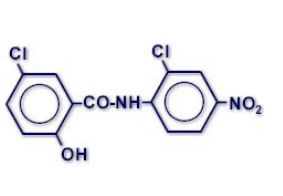
MARKETING & USAGE
Decade of introduction: 1950
Introduced by: BAYER
Some original brands: MANSONIL, LINTEX, YOMESAN
Patent: Expired (Particular formulations may be still patent-protected)
Use on LIVESTOCK: Yes, very scarce
Use on DOGS and CATS: Yes, scarce
Main delivery forms:
Drenches
Feed additives
Tablets, pills, etc
Use in human medicine: Yes
Use in public/domestic hygiene: Yes, against snails
Use in agriculture: Yes, against snails
Generics available: Yes, a few
SPECIFIC FEATURES
Niclosamide is a veteran salicylanilide anthelmintic nowadays very
scarcely used in pets and livestock, because it has been replaced by more
effective compounds. It is available in a few countries in the form
of drenches, tablets, pills, etc. and feed additives.
Due to its narrow spectrum of activity it is mostly used in combination with
a broad-spectrum nematicide (e.g. benzimidazoles, levamisole, etc.)
Efficacy of niclosamide
Niclosamide is a good taenicide (= tapeworm killer) effective against
several parasitic tapeworms of livestock and pets
(e.g. Taenia spp, Moniezia spp) and also against rumen
flukes ( Paramphistomum spp) and blood flukes ( Schistosoma spp). This
is in contrast with most other salicylanilides, which are mainly flukicides and
not at all taenicides.
Niclosamide is also used against aquatic snails that are vectors of human
schistosomiasis (also known as bilharzia, bilharziosis or snail fever), as well
as a human medicine against various tapeworm infections.
It has no efficacy whatsoever against roundworms (nematodes) and
other important parasitic flukes such as liver flukes (Fasciola hepatica),
nor against external parasites.
Niclosamide has no residual effect. This means that a single
administration will kill the parasites present in the host at the time of
treatment, but will not protect the host against re-infestations.
Pharmacokinetics of niclosamide
After oral administration niclosamide is only marginally absorbed into the
bloodstream. Absorbed niclosamide is quickly metabolized and excreted.
Unabsorbed niclosamide remains vastly unchanged in the digestive tract
and is quickly excreted through feces. Neither the parent molecule nor its
metabolites are detected in blood or urine.
This low absorption allows a high safety margin for use on animals.
Mechanism of action of niclosamide
The molecular mode of action of salicylanilide, including niclosamide, is
not completely elucidated. They all are uncouplers of the oxidative
phosphorylation in the cell mitochondria, which disturbs the production of
ATP, the cellular “fuel”. This impairs the parasites motility and probably
other processes as well.
Niclosamide acts on the tapeworms also through inhibition of glucose
absorption.