
Oxyclozanide is a salicylanilide anthelmintic. It is used in the treatment and control
of Fascioliasis in ruminants mainly domestic animals like Cattle, Sheep and Goats.
It mainly acts by uncoupling of Oxidative phosphorylation in flukes.
Oxyclozanide is a veteran narrow-spectrum flukicide scarcely used in livestock,
almost only in ruminants. It is available in the form of drenches, often mixed with a
broad-spectrum nematicide.
Efficacy of oxyclozanide:
Oxyclozanide is effective against adult liver flukes (Fasciola hepatica) as well as
against immature stages in the tissues (older than 10 weeks). Efficacy
against rumen flukes (Paramphistomum spp) is limited. It has no
effficacy whatsoever against roundworms and tapeworms.
As most other salicylanilides oxyclozanide has a residual effect, i.e., it not only
kills the parasites present in the host at the time of treatment, but also protects
against re-infestation for a period of time (up to several weeks) that depends on the
dose and the specific parasite.
Pharmacokinetics of oxyclozanide:
After oral administration oxyclozanide is slowly absorbed into the bloodstream.
Maximum blood concentrations in sheep and cattle are reached about 24 hours
after treatment. Oxyclozanide binds strongly and almost completely (>99%) to
plasma proteins.
Oxyclozanide is excreted mainly through bile and feces (up to 80%) the rest in urine
and <0.1% in milk, mostly as unchanged oxyclozanide. Excretion half-life in sheep
is about 7 days. Oxyclozanide excretion in milk of lactating cows is rather low, and
several oxyclozanide products are approved for use on dairy animals.
Mechanism of action of oxyclozanide:
The molecular mode of action of salicylanilide, including oxyclozanide, is not
completely elucidated. They all are uncouplers of the oxidative
phosphorylation in the cell mitochondria, which disturbs the production of ATP,
the cellular “fuel”. This seems to occur through suppression of the activity of
succinate dehydrogenase and fumarate reductase, two enzymes involved in this
process. This impairs the parasites motility and probably other processes as well.
Chemical Name:
3,35,56-pentachloro-2-`hydroxy salicylanilide;
2,3,4,-trichloro-N-(3.5-Dichloro-2-hydroxyphenyl)-6-hydroxybenzamide.
C A S Resgistry No: (2277-92-1)
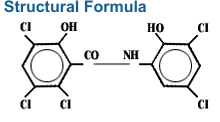
Molecular Formula:
C13 H6 CI5 NO3
Shelf Life:
Stable for five years under normal storage conditions.
Packing:
25/50kg Fiber or HDPE drums with LDPE liner